Best Community College Degrees with High Earning Potential
See if you qualify for training programs
Answer a few questions in 2 minutes. Free, no commitment.
Choosing a college path is one of the most significant financial decisions a person can make. For millions of Americans, the community college route is delivering real results: strong salaries, short programs, and a cost that fits real-life budgets.
Community college tuition averages $4,150 per year for in-district students, according to the College Board. Federal financial aid, including Pell Grants worth up to $7,395 per year, brings that cost down significantly, and for many students, to zero. Associate degree holders in healthcare, technology, business, and the skilled trades are stepping into careers with starting salaries that consistently beat the national median wage of $49,500.
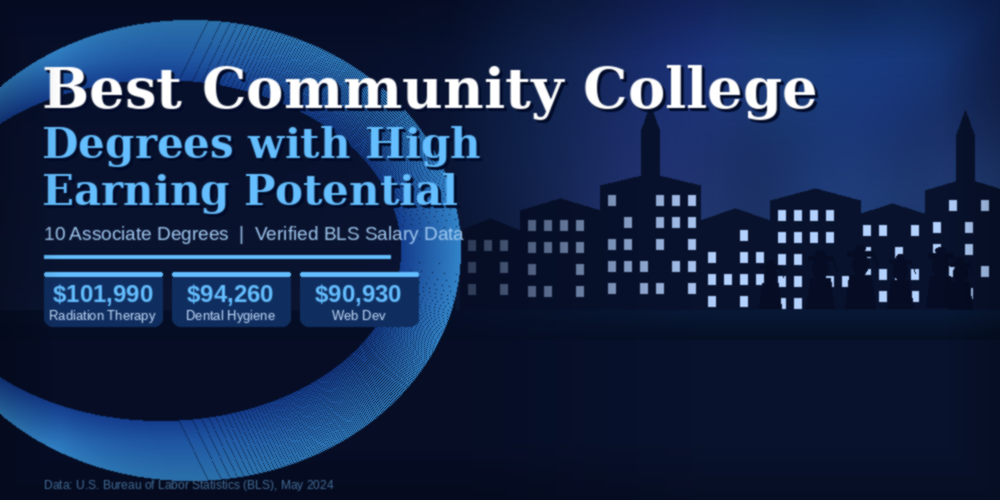
This guide covers 10 of the highest-paying community college degrees available today, organized by field, alongside verified salary and job growth data, and a practical breakdown of what attendance actually costs so you can plan your path with confidence.
7. Paralegal / Legal Assistant
- Median annual wage: $61,010 (BLS, May 2024)
- Job growth (2024–2034): Little or no change | Annual openings: ~39,300
- Minimum education: Associate degree or certificate in paralegal studies
Paralegals and legal assistants support attorneys by conducting legal research, drafting documents, organizing case files, and helping prepare for hearings and trials. While overall employment growth is projected to remain flat over the next decade, the BLS projects approximately 39,300 annual openings through 2034, the majority driven by the need to replace workers who retire or transition out of the field. Specializing in corporate law, real estate, or compliance tends to support stronger earning potential, with the top 10% of paralegals earning above $98,990 per year.
8. Accounting Technology
- Median annual wage (Bookkeeping Clerks): $49,210 (BLS, May 2024)
- Job growth (2024–2034): -6% for bookkeeping clerks | Accountants and auditors: +5%
- Minimum education: Associate degree
Entry-level bookkeeping roles start near the national median wage, but this degree is most valuable as a foundation for career growth, not a destination on its own. An associate degree in accounting prepares students for roles as bookkeeping clerks, accounting assistants, and junior accounting technicians, while building the foundation for a full accounting career. Students who pursue additional coursework or a CPA credential path transition into accountant and auditor roles, where the BLS projects 5% job growth through 2034 and a median salary of $79,880. For students planning a longer-term trajectory in finance, this is one of the most practical foundational degrees community college offers.
🎓 Featured Program: Southern New Hampshire University — AS Accounting
High-Earning Technology Degrees from Community College
Technology is one of the fastest-growing sectors in the U.S. economy. Community colleges offer direct pathways into it, particularly through web development and network support roles that are accessible at the associate degree level.
9. Web Developer
- Median annual wage: $90,930 (BLS, May 2024)
- Job growth (2024–2034): 7%, much faster than average
- Minimum education: Associate degree
Web developers design, build, and maintain websites and web applications. The BLS projects 7% job growth through 2034, driven by continued expansion of e-commerce and the growing need for businesses to establish and maintain a functional online presence. An associate degree in web development or computer information systems provides the foundational programming, design, and database skills needed for entry-level roles. Many graduates supplement their degree with industry certifications to strengthen their candidacy with employers. The top 10% of web developers earn above $162,870 per year.
10. Computer Network Support Specialist
- Median annual wage: $60,340 (User Support) / $73,340 (Network Support) (BLS, May 2024)
- Job growth (2024–2034): -3% overall | Annual openings: ~50,500
- Minimum education: Associate degree
Computer network support specialists maintain and troubleshoot an organization's systems and networks. While the BLS projects a modest overall decline in the broader computer support category, it still projects approximately 50,500 annual openings through 2034, primarily driven by workforce turnover rather than job elimination. Network support roles pay more than general user support roles and provide a recognized entry point toward higher-level IT positions. Adding industry certifications such as CompTIA Network+ or Cisco CCNA alongside an associate degree meaningfully improves hiring outcomes and earning potential in this field.
🎓 Featured Program: Southern New Hampshire University — AS Computer Science
How Much Does Community College Actually Cost?
Understanding the full cost of attendance, including what financial aid is available, is an important part of making the decision to enroll.
Tuition: The average in-district community college tuition is $4,150 per year, according to the College Board Trends in College Pricing 2025–26. A complete two-year associate degree costs approximately $8,300 in tuition before any financial aid is applied.
Federal Pell Grant: The Federal Pell Grant is the primary source of grant-based financial aid for community college students. For 2025–26, the maximum award is $7,395 per year, according to Federal Student Aid. This is grant funding. It does not need to be repaid. Eligible students can receive the Pell Grant for up to 12 semesters.
What this means in practice:
- Average in-district tuition: ~$4,150/year (College Board, 2025–26)
- Maximum federal Pell Grant: $7,395/year (StudentAid.gov, 2025–26)
- For eligible students: the Pell Grant can fully cover tuition and leave a remaining balance for books and fees
- More than 30 states offer additional last-dollar or tuition-free scholarship programs on top of federal aid
Is community college free? For students who qualify for the maximum Pell Grant, net tuition can reach zero. Eligibility is determined by income and household size. To find out what you qualify for, submit the Free Application for Federal Student Aid (FAFSA) at studentaid.gov. There is no cost to apply, and the FAFSA is required to access any federal grant or loan funding.
The financial picture becomes even clearer when paired with salary outcomes. A total tuition investment of $0 to $8,300 for a two-year degree, followed by entry into a field that pays above the national median, represents a return on educational investment that is difficult to match through most other postsecondary pathways.
How to Choose the Right Community College Program
The right program depends on your career goals, the schools available in your area, and the local job market. These criteria are worth evaluating before you enroll:
- Confirm accreditation. Healthcare programs should hold accreditation from a recognized body. For radiologic and radiation therapy programs, look for approval from the Joint Review Committee on Education in Radiologic Technology (JRCERT). Accreditation determines whether your credential is accepted by employers and state licensure boards.
- Check state and metro-level wages. The BLS Occupational Outlook Handbook provides salary data broken down by state and metropolitan area. Earnings in your region may be higher or lower than the national median.
- Ask about job placement outcomes. Programs with active employer relationships and career services offices tend to produce stronger employment results. Asking directly about placement rates and hiring partnerships is a reasonable step when evaluating any program.
- Consider earn-while-you-learn options. For trade programs, many apprenticeship pathways pay students from day one. HVAC apprentices, for example, commonly earn $18–$25 per hour while completing their credential, making it possible to finish training without taking on debt and without leaving the workforce entirely.
Your Next Steps: Starting in 2026
Community college programs accept students each semester: fall, spring, and in many cases summer. Competitive programs, particularly in dental hygiene, radiation therapy, and nuclear medicine technology, fill quickly and sometimes carry waitlists. Starting the enrollment process early gives you access to more options.
Step 1: File the FAFSA at studentaid.gov. This single step determines your eligibility for federal grants, state aid, and institutional scholarships. There is no cost to apply.
Step 2: Use the BLS Occupational Outlook Handbook to research salary data and job growth projections for careers you are considering, including state-level wage breakdowns specific to your area.
Step 3: Review the featured programs listed throughout this guide. Contact schools directly to ask about upcoming enrollment dates, clinical or apprenticeship placements, and available financial aid packages.
Step 4: Apply before your target semester opens. High-demand programs have limited seats. Submitting your application early is the most reliable way to secure your spot.
A two-year associate degree is a direct, affordable, and employer-recognized pathway to financial stability. The salaries are supported by federal labor data. The demand is documented and growing. And with the right financial aid in place, the cost is far more manageable than most people assume before they look into it.