10 Highest-Paying Associate Degrees of 2026
See if you qualify for training programs
Answer a few questions in 2 minutes. Free, no commitment.
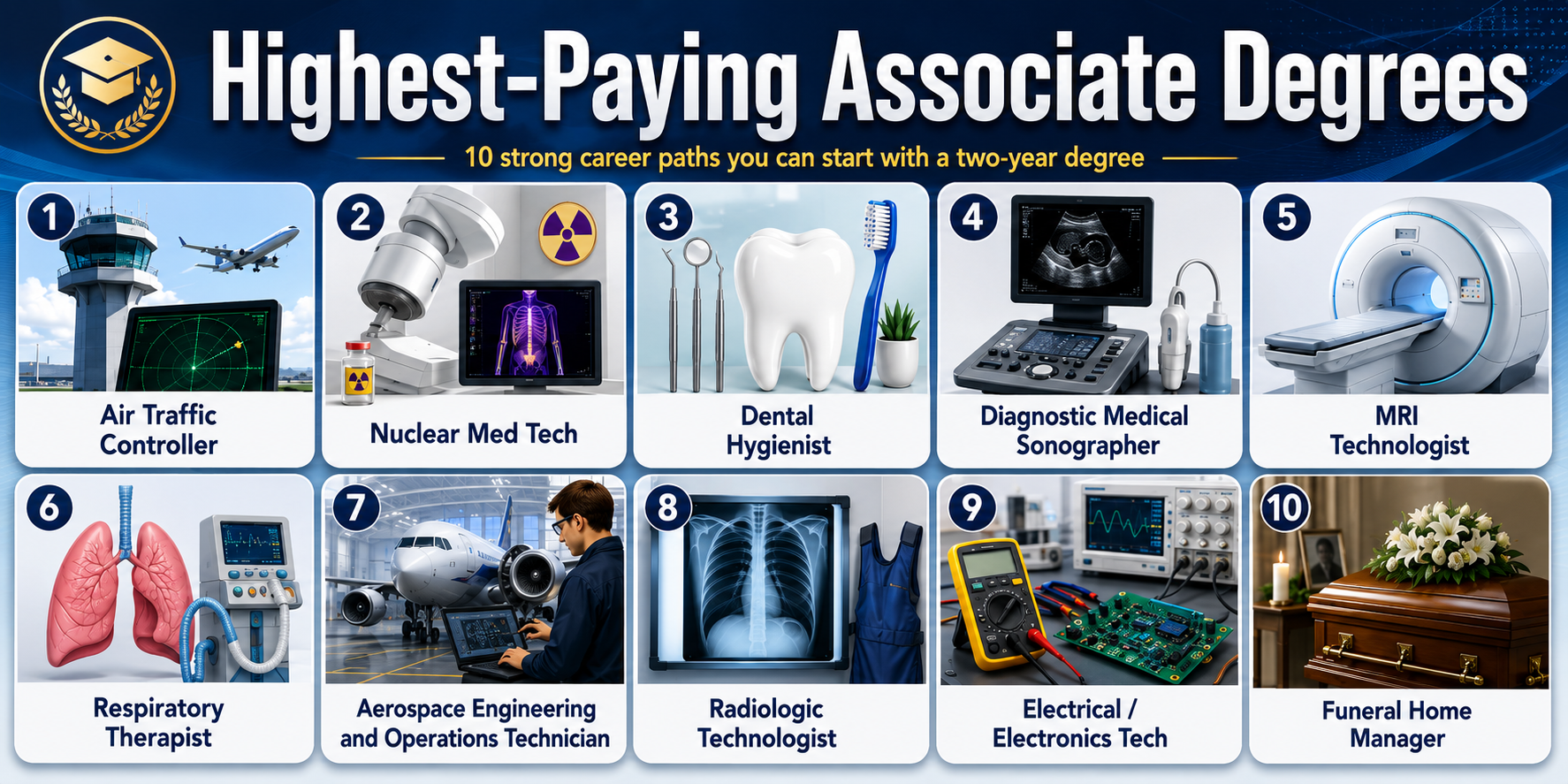
Two years of school. A paycheck that rivals what many four-year graduates earn. That is the deal a well-chosen associate degree can offer. Most people assume a bachelor's degree is the only road to real money, but the numbers tell a different story. According to the U.S. Bureau of Labor Statistics, several careers open to associate-degree holders pay well above $75,000 a year, a few clear six figures, and most take about two years to finish. This guide ranks the 10 highest-paying associate degrees on verified BLS salary and job-growth data, then gives you the context that actually matters when you choose: pay, outlook, licensing, and what moves your earnings once you are on the job.
Associate Degree Career (ranked) | Median Salary (BLS, May 2024) | Job Growth 2024-2034 |
|---|---|---|
| $144,580 | 1% (slower) |
| $97,020 | 3% (average) |
| $94,260 | 7% (much faster) |
| $89,340 | 13% (much faster) |
| $88,180 | much faster (group) |
| $80,450 | 12% (much faster) |
| $79,830 | 8% (much faster) |
| $77,660 | as fast as average (group) |
| $77,180 | 1% (slower) |
| $76,830 | 4% (average) |
What Makes an Associate Degree Worth It?
Here is a useful baseline: the median pay for all U.S. workers is about $49,500 a year. Every career on this list clears that by a wide margin, and none of them asks for four years of school or the debt that usually trails it. A few things worth knowing before you pick one:
- Most programs take about two years at a community college, though some health programs (dental hygiene among them) run longer.
- Many require a state license or national certification after graduation, which adds a few months and some exam fees.
- The BLS figures here are national medians, not ceilings. Your pay shifts with location, employer, and experience.
What to Weigh Beyond the Salary Number
Return on investment starts with program cost. A community college associate degree usually runs $5,000 to $25,000 total, against $60,000 to well over $120,000 for a four-year degree. On a sonographer or dental hygienist salary, you can earn back your tuition in under a year.
Licensing and certification add time. Dental hygienists, respiratory therapists, radiologic and MRI technologists, and funeral managers all sit for a board or licensing exam after graduation. Plan for an extra two to four months between your last class and your first paycheck.
Job growth varies sharply within this list. Sonographers (13%), respiratory therapists (12%), aerospace technicians (8%), and dental hygienists (7%) are all growing much faster than average. Air traffic controllers and electrical engineering technicians sit at just 1%. The trajectory tells you something starting salary can't: how steady the field will be a decade from now.
Location changes the numbers. National medians are a starting point, not a promise. Pay in your metro can land well above or below them, so look up your state on the BLS wage tool before you enroll.
How to Evaluate a Program Before You Enroll
- Accreditation matters. For healthcare programs, look for CAAHEP, JRCERT, or CoARC accreditation. An unaccredited program can keep you from sitting for your licensure exam.
- Check certification pass rates. Programs report them. A low pass rate is a fair thing to ask about.
- Confirm clinical rotations are included. Hands-on hours are required for licensure in most of the healthcare careers here.
- Ask whether the program qualifies you for your state's license. Requirements vary by state, and not every program is approved everywhere.
Frequently Asked Questions
What associate degree pays the most?
Air traffic controller is the highest-paying associate-level career, at a median of $144,580 a year, according to BLS. Among healthcare paths, nuclear medicine technologist ($97,020) and dental hygienist ($94,260) lead the pack.
Can an associate degree lead to a six-figure salary?
Yes. Air traffic controllers earn a median of $144,580, and nuclear medicine technologists, dental hygienists, and sonographers can reach or approach six figures in higher-paying states and with experience, even though their national medians land in the $89,000 to $97,000 range.
What is the most valuable associate degree in 2026?
It depends on your goals, but healthcare degrees win on pay-to-time ratio. Dental hygiene, sonography, and respiratory therapy pair strong salaries ($80,000 to $94,000) with much-faster-than-average growth, which puts them among the most valuable two-year paths you can choose.
How long does an associate degree take?
Most take about two years of full-time study. Some health programs run longer, dental hygiene often takes about three years, and licensure exams add a few months before you start working.
Your Next Step
The careers on this list are well-documented, consistently in demand, and reachable through programs that take about two years. What separates the people who land these jobs from the people who only read about them usually comes down to a decision and a start date. If one of these careers caught your eye, the next move is finding an accredited program near you and checking its enrollment requirements. The two-year investment is real, and so is the payoff.
Read More
All salary and employment data sourced from the U.S. Bureau of Labor Statistics Occupational Outlook Handbook, May 2024 data, with job-growth projections for the 2024-2034 period.