Key Points
- The strongest beginner IT certifications support specific first roles in help desk, computer support, networking, cybersecurity, cloud, or AI support.
- CompTIA A+ is the most widely cited starting credential for help desk and computer support technicians.
- Google IT Support is a certificate program, not an industry certification exam, but it offers structured beginner training that pairs naturally with CompTIA A+ prep.
- Cybersecurity and cloud credentials work best once you understand computer systems, networking, and troubleshooting basics.
- BLS reports a median annual wage of $61,550 for computer support specialists (May 2024), but earning a certification alone does not guarantee a job, salary, or promotion.
IT Certification vs IT Certificate: What's the Difference?
An IT certification is a credential earned by passing an exam from a technology organization. An IT certificate is a completion document from a course or training program. Both can support a beginner's path, but they prove different things.
Certification exams come from vendors and standards bodies such as CompTIA, Cisco, Microsoft, AWS, and ISC2. The credential travels with you because the exam content is the same everywhere. Common examples include CompTIA A+, Network+, Security+, Cisco CCNA, AWS Cloud Practitioner, and Microsoft Azure Fundamentals.
Certificate programs come from training providers and schools. The Google IT Support Professional Certificate is a well-known example of a certificate program rather than a certification exam. Some training programs prepare you for an industry certification exam, which gives you both: course-completion proof and a credential employers can verify directly.
Before applying to any program, check whether it prepares you for a specific certification exam, awards only a course-completion certificate, or does both. If a job posting requires a specific certification, you need the exam, not just a course on the topic.
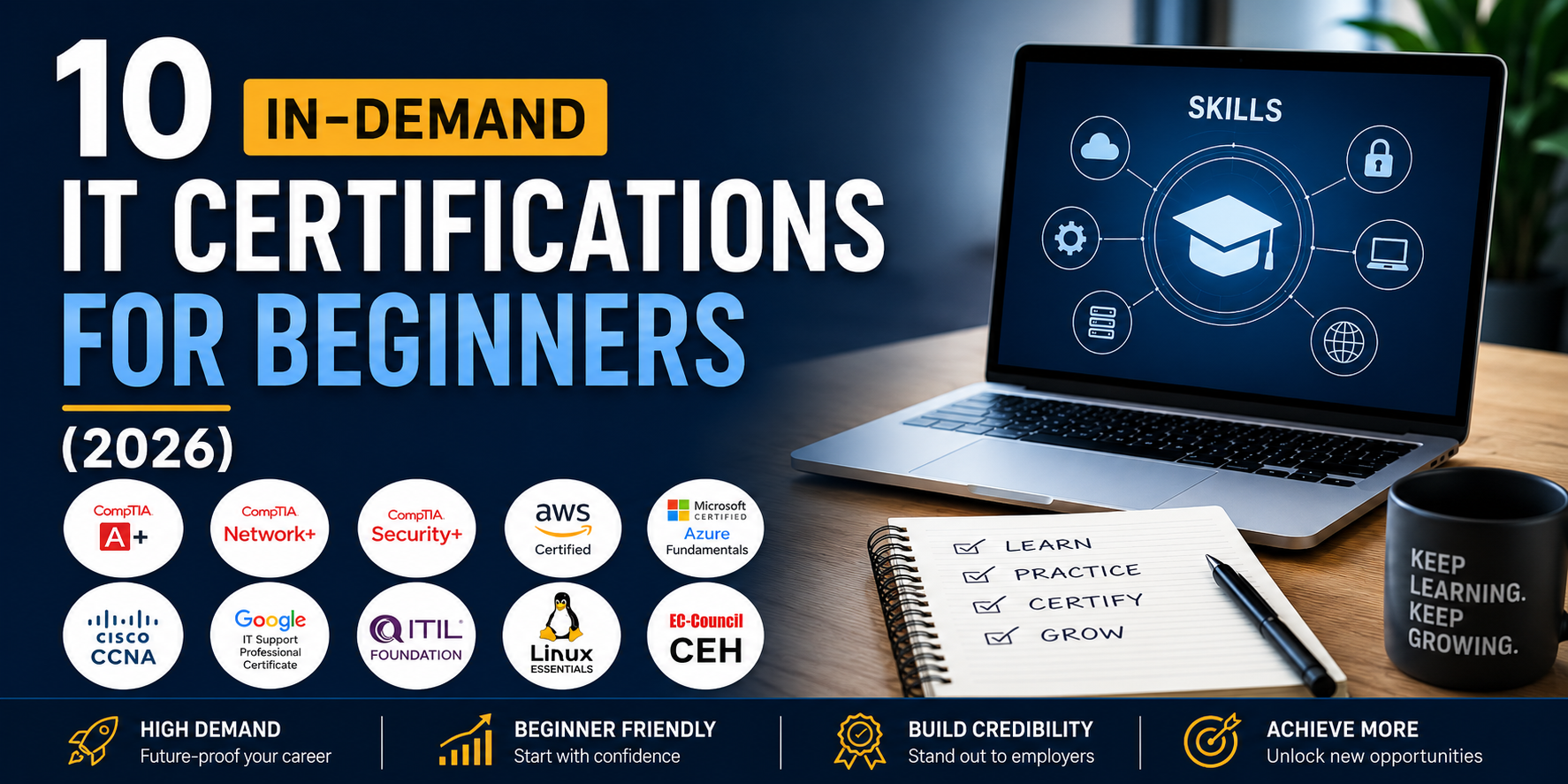
10 Best IT Certifications for Beginners in 2026
The strongest beginner credential is the one that matches your target first role. The list below covers exams and certificate programs across help desk, networking, cybersecurity, cloud, and AI support paths. Google IT Support is included as a certificate program because many beginners weigh it against CompTIA A+ when choosing where to start.
1. CompTIA A+
CompTIA A+ is the most widely recognized entry-level IT certification in the world. The two-exam credential covers hardware, operating systems, networking basics, mobile devices, security topics, and troubleshooting. It maps directly to the day-to-day work most beginners handle in their first IT role.
- Best for: Help desk, computer support, and PC technician paths
- Common first roles: Help desk technician, desktop support, PC technician, or computer support specialist
- Build toward: CompTIA Network+, CompTIA Security+, or a cloud fundamentals credential
2. Google IT Support Professional Certificate
The Google IT Support Professional Certificate is a beginner certificate program, not an industry certification exam, designed to teach foundational IT support skills in three to six months. Google's published curriculum covers troubleshooting, customer support, networking, operating systems, system administration, security, and AI use in IT support. Many students pair it with CompTIA A+ prep because the topics overlap heavily.
- Best for: Beginners with no prior IT background who want guided, structured training
- Common first roles: Help desk support, IT support trainee, or computer support assistant
- Pair with: CompTIA A+ or CompTIA Network+
3. CompTIA Network+
Networking is the natural next step after a help desk foundation. CompTIA Network+ validates networking knowledge across connectivity, IP addressing, troubleshooting, network security hardening, and cloud networking. It is vendor-neutral, which means the concepts apply across Cisco, Juniper, and any cloud provider environment.
- Best for: Building networking knowledge after A+ or as a parallel track
- Common first roles: Junior network support, help desk with networking duties, or network support trainee
- After this: Cisco CCST Networking, Cisco CCNA, or CompTIA Security+
4. Cisco CCST Networking
Cisco CCST Networking is Cisco's entry-level certification, positioned as a starting point for students who want a Cisco-specific path but are not yet ready for CCNA. The exam covers networking basics, addressing, security, and support skills tied to Cisco environments. Cisco positions CCST as a foundation toward the more advanced CCNA.
- Best for: Beginners aiming at a Cisco-focused networking career
- Common first roles: Entry-level network support, IT support with networking tasks, or junior technician
- Stack with: Cisco CCNA
5. Cisco CCNA
Cisco recommends about one year of hands-on networking experience before attempting CCNA, which makes it a stretch credential for true beginners rather than a first cert. The single exam covers network fundamentals, IP connectivity, IP services, security topics, and automation basics. CCNA still belongs on a beginner list because many career-changers complete a structured network technician program first, then sit for the exam.
- Best for: Students with some networking foundation who want a deeper Cisco-recognized credential
- Common first roles: Network technician, junior network administrator, or network support specialist
- After CCNA: Cybersecurity, cloud networking, or advanced Cisco certifications
6. CompTIA Security+
CompTIA Security+ is the most common entry-level cybersecurity certification and the baseline credential for many U.S. Department of Defense roles under DoD 8140. The exam covers threats and attacks, architecture and design, implementation, operations and incident response, and governance, risk, and compliance topics. The DoD approval is one reason Security+ appears frequently in government and contractor cybersecurity job postings.
- Best for: Building a cybersecurity foundation after networking and support exposure
- Common first roles: Help desk with security duties, junior security support, or security operations trainee
- After Security+: ISC2 Certified in Cybersecurity, CompTIA CySA+, or a vendor security path
7. ISC2 Certified in Cybersecurity (CC)
ISC2 Certified in Cybersecurity is an entry-level cybersecurity credential with a standard $199 exam fee and no prior experience requirement. The exam covers security principles, business continuity, disaster recovery and incident response, access controls, network security, and security operations. CC is accredited by the ANSI National Accreditation Board to the ISO/IEC 17024 standard and recognized under the U.S. Department of Defense 8140.03 framework. The lower price point compared with Security+ makes CC a more accessible cybersecurity starting point for some beginners.
- Best for: Beginners interested in cybersecurity who want a low-cost first credential
- Common first roles: Entry-level IT support with security exposure, security awareness support, or junior cyber trainee
- After CC: CompTIA Security+, CompTIA CySA+, or cloud security training
8. AWS Certified Cloud Practitioner
AWS Certified Cloud Practitioner is Amazon's entry-level cloud certification and the most accessible starting point for the AWS track. The exam covers cloud concepts, AWS services, security and compliance, billing and pricing, and support. AWS lists no required prior experience, which makes the credential accessible to students with little or no cloud background.
- Best for: Beginners adding cloud awareness on top of support or networking skills
- Common first roles: Cloud support trainee, IT support in AWS environments, or technical support roles touching cloud
- Build toward: AWS Solutions Architect Associate, AWS SysOps Administrator Associate, or CompTIA Cloud+
9. Microsoft Azure Fundamentals (AZ-900)
Microsoft Azure Fundamentals (AZ-900) covers cloud concepts, Azure architecture and services, and Azure management and governance. It is often the stronger fit if you want to work in environments built on Microsoft 365, Active Directory, Windows Server, and the broader Microsoft identity stack. Many help desk and support roles inside Microsoft-centric organizations list AZ-900 as a preferred credential.
- Best for: Beginners in Microsoft-heavy IT environments
- Common first roles: IT support trainee, help desk in a Microsoft shop, or cloud support beginner
- After AZ-900: Microsoft Certified Azure Administrator Associate or Microsoft security fundamentals
10. AWS Certified AI Practitioner
AI literacy is becoming a routine part of IT support and cloud work. AWS Certified AI Practitioner covers foundational AI and machine learning concepts, generative AI, and AWS AI services. AWS positions it as a credential for non-technical and entry-level technical roles. Treat it as an add-on after you understand IT support and cloud basics, not as a first credential on its own.
- Best for: Beginners adding AI awareness to support or cloud skills
- Common first roles: IT support, cloud support, or technical roles using AI tools
- Pair with: AWS Cloud Practitioner, Microsoft Azure AI Fundamentals, or deeper cloud training
How to Choose the Right IT Certification for Beginners
Choosing the right beginner IT certification is a sequencing decision: pick your first role, confirm the credential type, check costs and renewal, build hands-on practice, and compare training programs. Following this order keeps you from collecting credentials that don't connect to a real job target.
Step 1: Decide on Your First IT Role
Pick the role first, then the credential. The cleanest way to narrow your target role is to look at three to five entry-level IT job postings in your area and note which credentials appear most often in the requirements. This grounds your choice in real local hiring rather than online popularity rankings.
If you are still uncertain, ask yourself which IT task you would want to handle on day one: helping coworkers troubleshoot devices, configuring a network, investigating a security alert, or managing a cloud environment. Your answer points to the certification path that fits.
Step 2: Confirm It's an Exam, a Program, or Both
Read each program description carefully. A certification typically requires passing a specific exam from CompTIA, Cisco, AWS, Microsoft, ISC2, or another standards body. A certificate program awards completion credit after coursework but may not include sitting for the industry exam.
If a job posting requires CompTIA Security+, you need to pass the Security+ exam itself, not only complete a course on security topics. The strongest beginner training programs make this distinction clear: they tell you which certification exam you'll sit for, whether the program includes an exam voucher, and what happens if you fail and need to retake.
Step 3: Check Cost, Format, and Renewal Requirements
Beginner IT credentials vary in cost, exam format, and ongoing requirements. Before committing, check:
- Exam fee and any required retake fees
- Whether the training program includes an exam voucher
- Recommended prerequisite experience
- Renewal cycle and continuing education requirements (most major IT certifications renew on a three-year cycle)
- Practice labs, simulations, and hands-on components included with the program
A lower upfront price isn't always a better value. A program that costs more but includes labs, exam vouchers, and instructor support often produces stronger outcomes than a cheap self-study option.
Step 4: Pair Study with Hands-On Practice
Employers care about what you can actually do. Pair your certification study with practical work that you can describe in an interview:
- Build or repair a desktop computer
- Set up a home lab with virtual machines
- Practice command-line basics in Windows, macOS, and Linux
- Troubleshoot real Wi-Fi and network issues
- Complete cloud labs (most cert programs include them)
- Document mock support tickets to practice clear communication
Hands-on practice carries especially heavy weight in support, networking, cybersecurity, and cloud paths.
Step 5: Compare Training Programs Before You Commit
A strong IT certification training program tells you exactly which exam it prepares you for, whether an exam voucher is included, what labs are part of the curriculum, and what career services exist. Some students compare beginner IT certifications with the highest-paying associate degrees before deciding between a single credential and a longer college path.
IT Certifications to Skip as a Beginner
Some IT certifications are not appropriate as a first credential. Starting too advanced means studying for an exam that assumes years of experience you don't yet have, which wastes money and study time without producing a usable credential.
- CISSP: built for experienced cybersecurity professionals; ISC2 requires five years of relevant work experience for full certification
- CISM: designed for security managers, not entry-level analysts
- PMP: a project management credential, not an IT support certification
- CEH: EC-Council typically expects two or more years of cybersecurity work experience
- Advanced cloud architect certs (AWS Solutions Architect Professional, Azure Solutions Architect Expert): assume hands-on infrastructure experience
- RHIT: a health information management credential, not a general IT certification
- Advanced vendor certifications such as CCIE, AWS Security Specialty, or Microsoft Cybersecurity Architect Expert: assume real workplace experience
The pattern: most advanced certifications assume you've already done the foundational work. Earning a foundation credential like CompTIA A+, Network+, Security+, or a cloud fundamentals exam first makes the advanced certifications meaningful when you eventually pursue them.
IT Certification Salary and Job Outlook
Salary and job outlook for IT careers depend on the role, certifications, employer, location, and hands-on experience. Certifications support your training but do not guarantee a specific salary or position.
BLS reports a median annual wage of $61,550 for computer support specialists as of May 2024. Within that group, computer user support specialists earned $60,340 and computer network support specialists earned $73,340. Overall employment is projected to decline 3% from 2024 to 2034.
Despite the projected decline, BLS still projects about 50,500 openings per year on average for computer support specialists, driven largely by replacement needs as workers transfer to other occupations.
For cybersecurity-focused students, BLS reports a median annual wage of $124,910 for information security analysts in May 2024. Employment is projected to grow 29% from 2024 to 2034, with about 16,000 openings per year on average.
For networking-focused students, BLS reports a median annual wage of $96,800 for network and computer systems administrators in May 2024. Employment is projected to decline 4% from 2024 to 2034, with about 14,300 openings per year on average.
Across the broader computer and information technology field, the median annual wage was $105,990 in May 2024. BLS projects roughly 317,700 openings per year through 2034, which BLS describes as much faster than the average for all occupations.
Long-term earnings in IT depend less on the starting credential and more on hands-on experience, troubleshooting ability, communication skills, and continued certification stacking.
Dreambound is a free platform that helps you compare IT training programs across the United States. Filter programs by the certification each one prepares you for, starting from the role you're targeting first.
IT Certification Training Programs on Dreambound
The programs below are organized by track so you can compare IT support, cybersecurity, and networking or cloud options side by side. Program details can change, so confirm current tuition, length, format, certification preparation, and financial aid on each program page before applying.