What Does a Career in Psychology Actually Look Like?
Psychology is not a single job. It is a field that spans clinical practice, education, research, corporate settings, government work, and the legal system. The licensed title of "psychologist" requires a doctoral degree, but a psychology background supports dozens of roles across multiple degree levels, many of which do not require a doctorate at all.
That distinction matters. Many students assume a psychology career means years of graduate school before they can work in the field. That is true for some paths. For others, a bachelor's or master's degree opens well-paying roles without a decade of additional training.
The three broad categories of psychology work are:
- Clinical and counseling work, including psychologists, therapists, counselors, and social workers who work directly with individuals, families, or groups on mental health challenges
- Research and academic work, including behavioral scientists, research coordinators, and university faculty who study human behavior and advance the field's knowledge base
- Applied and organizational work, including industrial-organizational psychologists, human resources professionals, and behavioral specialists who apply psychological principles in corporate and institutional settings
One development worth noting heading into 2026 is how much telehealth has reshaped clinical practice. Many licensed counselors, therapists, and psychologists now conduct a significant portion of their sessions virtually. For students, this means greater geographic flexibility when building a client base or finding employment, especially in master's-level counseling roles where private practice through a telehealth platform is increasingly viable early in a career.
Each category has its own degree requirements, salary range, and career trajectory.
What Can You Do With a Psychology Degree?
The answer depends largely on how far you take your education.
With a Bachelor's Degree
A bachelor's in psychology does not qualify you for independent clinical practice, but it is a solid foundation for a range of entry-level roles and a strong first step toward graduate study. Common positions include:
- Case manager or case aide in social services or community health organizations
- Behavioral health technician or psychiatric technician
- Research assistant in academic or clinical settings
- Human resources assistant or coordinator
- Substance abuse counselor (in some states, with additional certification)
- Child and family services worker
A psychology bachelor's degree also prepares students well for graduate programs in psychology, counseling, social work, law, medicine, or business. According to data from the American Psychological Association, approximately 45% of psychology bachelor's degree holders go on to earn a graduate degree in some field.
With a Master's Degree
A master's degree expands your clinical and professional options considerably. With the appropriate licensure, master's-level graduates can practice as independent therapists and counselors. Common roles include:
- Licensed Professional Counselor (LPC)
- Licensed Marriage and Family Therapist (LMFT)
- Licensed Clinical Social Worker (LCSW)
- School psychologist (in many states, a specialist-level or master's degree is sufficient)
- Industrial-organizational psychologist (many I-O roles accept master's-level candidates)
- Human resources manager or training and development specialist
Master's programs typically take two to three years to complete, and licensure requires additional supervised clinical hours after graduation, usually between 2,000 and 4,000 hours depending on the credential and state.
With a Doctoral Degree
A doctoral degree, either a Ph.D. or a Psy.D., is required to use the title "psychologist" and to practice independently in a clinical setting in most states. The American Psychological Association is the primary programmatic accreditor for doctoral and master's programs in clinical, counseling, and school psychology in the United States. Ph.D. programs emphasize research and are frequently funded, meaning tuition is waived and students receive a stipend. Psy.D. programs focus on clinical practice and are generally not funded, which is a financial reality worth factoring into your decision. Doctoral-level roles include:
- Clinical psychologist
- Counseling psychologist
- Neuropsychologist
- Forensic psychologist
- Research psychologist or university faculty
- Industrial-organizational psychologist at senior and consulting levels
The full path from a bachelor's degree to licensure as a psychologist typically takes eight to twelve years.
Psychology Career Salary and Job Outlook
Salaries in psychology vary by specialization, degree level, work setting, and geographic location. Here is what the most recent government data shows across the primary career paths.
Psychologists
According to the U.S. Bureau of Labor Statistics (May 2024), the median annual wage for all psychologists was $94,310. The lowest 10% earned below $54,860, and the highest 10% earned above $157,330.
Within the broader psychologist category, salaries differ by specialization:
- Clinical and counseling psychologists: median of $96,100
- Industrial-organizational psychologists: median of $109,840
- School psychologists: approximately $87,550
Overall employment of psychologists is projected to grow 6% from 2024 to 2034, which is double the national average growth rate of 3% for all occupations. About 12,900 positions are expected to open each year on average over the decade.
Mental Health and Substance Abuse Counselors
This is one of the fastest-growing occupational categories in the U.S. economy right now. According to the U.S. Bureau of Labor Statistics, the median annual wage for substance abuse, behavioral disorder, and mental health counselors was $59,190 in May 2024. Employment in this category is projected to grow 17% from 2024 to 2034, with about 48,300 positions opening each year. The BLS notes that increased demand is driven by a growing number of people, including young adults, seeking treatment for mental health and behavioral disorders.
The BLS has separately reported that mental health-related employment has grown steadily over the past decade and that strong growth is projected to continue well into the 2030s. Outpatient mental health centers and offices of mental health practitioners have seen particularly strong expansion in that period.
Marriage and Family Therapists
According to the U.S. Bureau of Labor Statistics, marriage and family therapists earned a median annual wage of $63,780 in May 2024. Employment is projected to grow 13% from 2024 to 2034, another rate the BLS classifies as much faster than average. About 7,700 positions are expected to open each year.
Roles Beyond Clinical Practice
Psychology also supports well-compensated roles outside of direct patient care. Human resources managers, a common path for psychology graduates, earned a median annual wage of $140,030 in 2024, according to the BLS. Training and development managers earned a median of $127,090. Both are roles that can be reached with a bachelor's or master's degree, without a clinical licensure requirement.
Thinking about which psychology path fits where you are right now? Browse accredited programs by degree level at Dreambound and see what is available in your state.
The Demand Behind the Numbers
The salary and growth projections above are grounded in a real and measurable public need. According to NIMH, roughly 23% of U.S. adults experienced a mental illness in 2022, yet only about half receive treatment. That treatment gap represents both a public health challenge and a sustained source of workforce demand that shows no sign of easing through the rest of the decade.
The American Psychological Association's 2023 Practitioner Pulse Survey found that over half of psychologists reported seeing an increase in symptom severity among their patients over the prior twelve months, and 42% reported an increase in the length of treatment their patients required. A separate APA report found that 60% of psychologists had no openings for new patients, reflecting a workforce stretched well beyond its current capacity.
For students considering this field, that context matters. The demand for psychology professionals is structural, not tied to a single event or economic cycle. It reflects a population that is increasingly seeking mental health support and a workforce that, by most current measures, cannot fully meet that demand.
What Student Interest Data Shows
The shift in student interest toward psychology shows up in real program selection behavior as well.
According to Dreambound's 2025 Student Choice and Interest Report, which tracked student activity across more than 500 vocational training program categories in the United States, psychology with a mental health concentration was the single most-saved program on the platform in 2025, with over 2,000 student saves. That marks a sharp jump from 2024, when the same program ranked ninth. It was the largest year-over-year rise in student interest of any program category on the platform.
Combined with psychology programs focused on addictions, which drew an additional 1,443 saves in 2025, behavioral health programs captured over 3,400 total saves, the largest share of student interest of any career category on the platform.
Psychology also appeared in the top chosen programs for the first time in 2025, meaning students are not just researching the field. They are actively selecting programs.
How Long Does It Take and What Does It Cost?
This is where honest expectations matter most, and where many students are surprised.
For students pursuing full licensure as a psychologist, the timeline from a bachelor's degree to independent practice is eight to twelve years. That includes a four-year undergraduate program, a doctoral program lasting four to seven years, a one-year predoctoral internship, and postdoctoral supervised hours that vary by state before full licensure is granted.
Licensing also requires passing the Examination for Professional Practice in Psychology (EPPP), a standardized exam required in all U.S. states and the District of Columbia for independent practice. Licensing requirements vary by state, so students should check the specific rules in the state where they plan to practice.
On the financial side, the degree type makes a substantial difference. Ph.D. programs in clinical psychology are often funded, meaning tuition is waived and students receive a stipend in exchange for research or teaching. Psy.D. programs, which are focused on clinical practice rather than research, are generally not funded. Total student loan debt for Psy.D. graduates can exceed $200,000 to $300,000 at some institutions. That figure is worth running the numbers on carefully before committing to a specific program.
For students pursuing master's-level licensure as an LPC, LMFT, or LCSW, the path is shorter. Most students reach independent practice within five to seven years from a bachelor's degree. The financial investment is lower, and the timeline to earning is considerably faster.
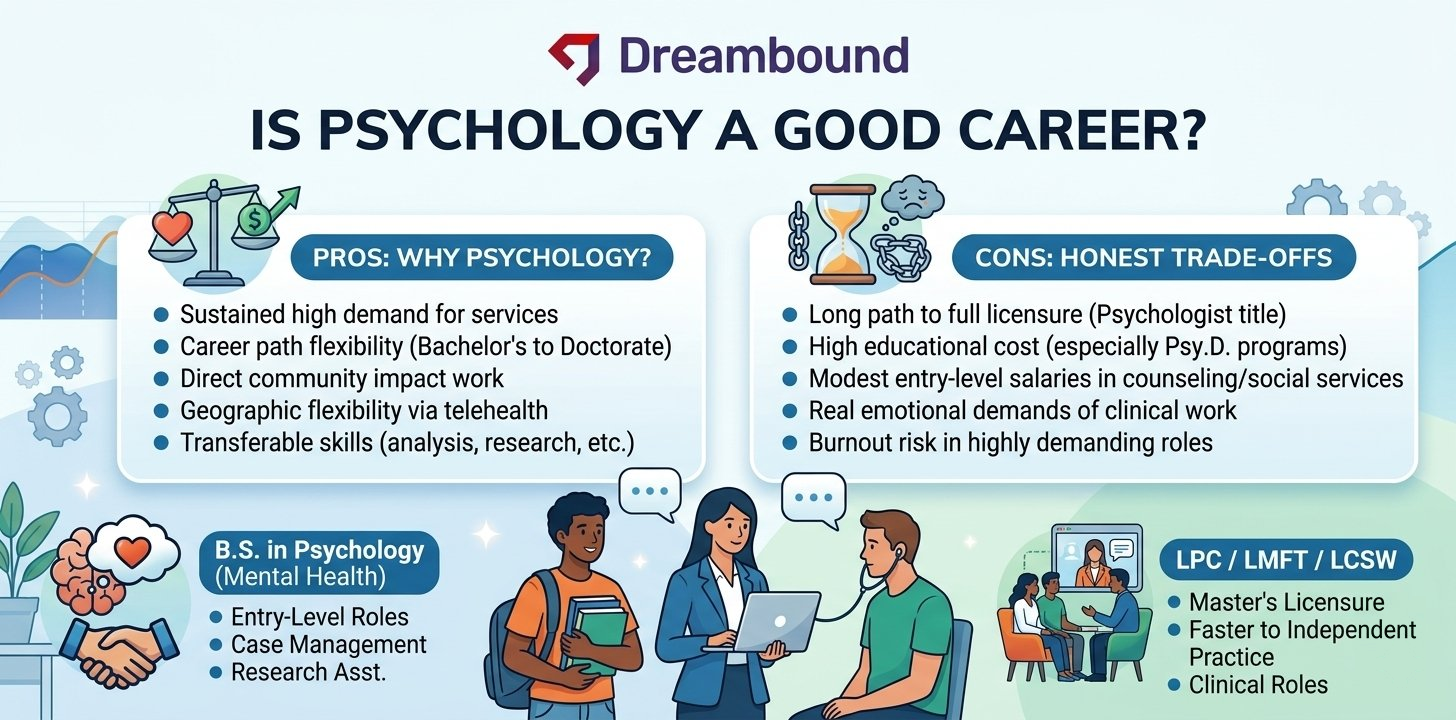
Pros and Cons of a Psychology Career
Psychology is a field with genuine strengths and genuine trade-offs.
The case for psychology as a career:
- Strong and growing demand across clinical, counseling, research, and organizational settings, projected to hold well through the 2030s
- Wide range of paths that support different interests, degree levels, and timelines
- Work that directly impacts the well-being of individuals and communities
- Competitive salaries at the doctoral level, and stable compensation at the master's level
- Flexibility in work setting, including private practice, telehealth, schools, hospitals, and corporations
- Transferable skills in communication, behavioral analysis, and research that carry value across industries
The honest trade-offs:
- Full licensure as a psychologist requires a long timeline, typically eight to twelve years from a bachelor's degree
- Psy.D. programs are frequently unfunded, and student loan debt can be substantial depending on the institution
- Entry-level salaries in counseling and social services are modest relative to the educational investment, particularly in nonprofit and government settings
- Clinical work carries real emotional demands. Regular engagement with trauma, crisis, and severe mental illness requires deliberate self-care practices, and burnout is a recognized occupational risk in the field
- Building a private practice takes time, and early-career income in that setting is often lower than in institutional roles before a client base is established
These trade-offs do not make psychology a poor choice. They make it a choice that rewards clear planning. Students who enter with realistic expectations and a defined path tend to find the work deeply worth it. Those who underestimate the timeline or the financial commitment often find the early years harder than they expected.
Who Is Psychology a Good Career For?
Psychology tends to be the right fit if:
- You have a sustained interest in human behavior, mental health, or both, strong enough to carry you through a demanding educational path
- You are comfortable with a significant time investment before reaching full professional independence
- You want work with direct impact on individuals or communities, whether in a clinical, educational, or organizational role
- You have a specific specialization in mind, such as forensic psychology, industrial-organizational psychology, or child and adolescent development, that aligns with your skills and interests
- You are open to starting at the master's level, gaining supervised clinical experience, and deciding later whether a doctoral program fits your long-term goals
Psychology may not be the right fit if:
- You want to be working and earning in your field within one to two years, in which case shorter certificate or vocational programs are a better match for your timeline
- You are primarily focused on maximizing early-career income, as entry-level salaries in counseling and behavioral health are moderate, and the higher-earning specializations require doctoral-level training
- You are not prepared for the emotional weight of clinical work, which involves regular contact with people navigating serious mental health challenges
A psychology bachelor's degree also does not lock you into one path. Many graduates spend a few years working in a related role before applying to graduate programs, which often results in stronger applications and clearer career goals.