Online Medical Billing and Coding Classes: Cost & Timeline
See if you qualify for Medical Billing and Coding programs
Answer a few questions in 2 minutes. Free, no commitment.
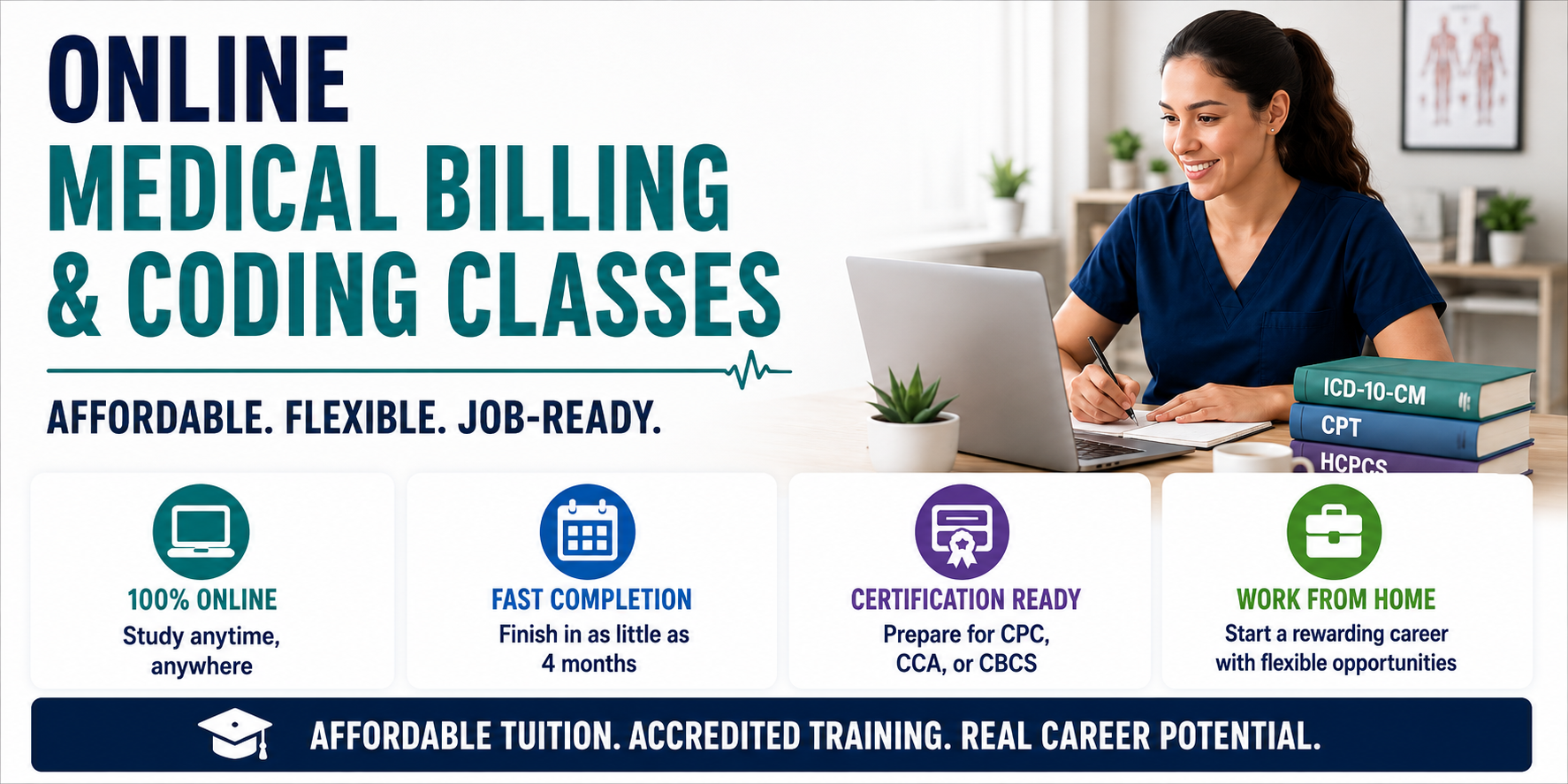
You can complete medical billing and coding training entirely online, and most accredited programs run about four to twelve months and cost roughly $1,000 to $4,500 before exam fees. Online classes prepare you to translate medical procedures and diagnoses into the standardized codes used for insurance claims, and they lead to entry-level credentials like the CPC, CCA, or CBCS. Medical records specialists, the federal category that covers billers and coders, earn a median of $50,250 a year, and much of the work can be done from home. Programs advertised as four weeks or free do exist, but the genuinely short ones are usually not accredited, and free courses rarely include the certification that gets you hired. The difference between a smart choice and a wasted one comes down to accreditation, the real cost once the exam is added, and the true timeline.
Medical Billing and Coding Salary and Job Outlook
Medical records specialists, the BLS category that covers billers and coders, earn a median of $50,250 a year, or about $24.16 an hour. The lowest 10% earn under $35,780 and the highest 10% earn more than $80,950, so pay climbs with experience and credentials. Employment is projected to grow 7% from 2024 to 2034, much faster than the average for all occupations, with about 14,200 openings a year, according to the U.S. Bureau of Labor Statistics.
Automation is changing the day-to-day rather than erasing the role. AI tools now handle some routine code lookups and first-pass claims, which is shifting demand toward people who can audit AI-generated codes, manage denials, and work the complex cases that need human judgment. That makes a recognized certification and current coding knowledge more useful over time, not less.
Frequently Asked Questions
Can medical billing and coding be done online?
Yes. Medical billing and coding suits online study because the work is records-based, and accredited schools offer the same coursework online that they teach in person. Most programs are self-paced, so you can study around a job. The job itself is also commonly done remotely once you are certified.
Can I take the billing and coding exam online?
Yes. The AAPC, AHIMA, and NHA all offer their certification exams through live online proctoring, so you can test from home with a webcam and a check of your ID and workspace. You can also test at an in-person center if you prefer. The exam fee is separate from your course tuition.
What is the cost of a medical coding course online?
Online courses usually cost about $1,000 to $4,500 in tuition. Add the certification exam, which runs $199 to $425 depending on the credential, plus a $229 annual AAPC membership if you take the CPC. Self-study paired with an exam can cost $500 to $900 if you already have healthcare experience.
Can you become a medical coder online for free?
Not entirely. Free courses and videos can teach you the basics, but they do not include the certification exam that employers look for, and that exam always carries a fee. The most affordable real path is a low-cost accredited program paired with one entry-level exam like the CCA or CBCS. You can compare low-cost options on Dreambound.
Choosing the Right Online Program for You
The right online program depends on where you are starting from, not on which one has the flashiest pitch. If you are still deciding whether the field fits, the remote-friendly work and the $50,250 median are a good gut check. When you are comparing programs, weigh the total cost with the exam included, the credential it targets, and how fast you can realistically finish, not just the monthly payment. Once you know your budget and timeline, pick an accredited program that matches them and reach out to the school to confirm start dates and any aid. Putting your options next to each other on Dreambound makes that final call a lot clearer.