Phlebotomy vs Medical Assistant: Which Should You Actually Enroll In?
See if you qualify for Phlebotomy programs
Answer a few questions in 2 minutes. Free, no commitment.
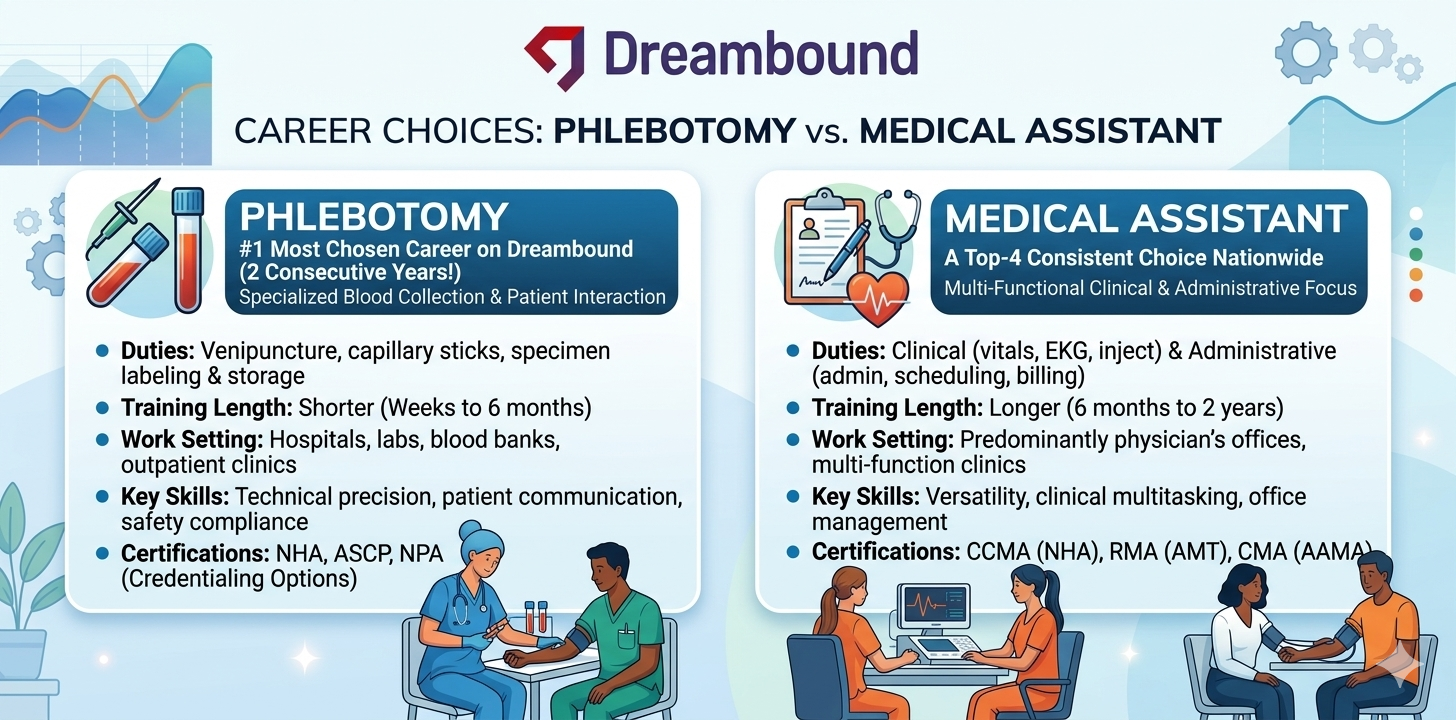
Phlebotomy and medical assisting are two of the most accessible careers in healthcare. Both involve working directly with patients, both have relatively short training programs, and both have a strong job market behind them. What separates them is the scope of the work, the training required, and the direction each one can take your career.
This article covers both careers in detail, drawing from the latest U.S. Bureau of Labor Statistics data and student program data from Dreambound's 2025 Student Choice and Interest Report, so you have what you need to make a clear, confident decision.
Medical Assistant Salary and Job Growth
According to the U.S. Bureau of Labor Statistics (May 2024):
- Median annual salary: $44,200
- Projected job growth (2024 to 2034): 12%, classified by the BLS as "much faster than average"
- Estimated annual job openings: approximately 112,300
- Total employed medical assistants in 2024: 811,000
While the median salaries for both professions are comparable, the long-term earning potential for medical assistants tends to increase more substantially with experience and specialization. Medical assistants who move into roles in cardiology, oncology, or office management often earn higher compensation over time.
Both careers are supported by a shared growth driver: the aging of the U.S. population. As demand for healthcare services continues to rise, employment opportunities for both phlebotomists and medical assistants are projected to grow alongside it.
What Student Program Data Reveals
Beyond government projections, real student behavior adds useful context to how prospective healthcare workers are approaching these two careers.
According to Dreambound's 2025 Student Choice and Interest Report, which analyzed student activity across more than 500 vocational training program categories in the United States, phlebotomy ranked as the most chosen program on the platform for two consecutive years, in both 2024 and 2025. In this context, "chosen" reflects students who selected a program and submitted their information to a training provider, indicating active intent to pursue that path rather than passive interest.
Medical assistant training maintained a consistent position as a top-four program over the same period, demonstrating steady and reliable demand across the country.
The report also found that healthcare certifications, including phlebotomy, showed the strongest follow-through rates of any program category on the platform. Students who explored phlebotomy programs were among the most likely to follow through and sign up for a program, which reflects a high level of decision confidence among prospective students in this area.
Role Overlap: Can Medical Assistants Do Phlebotomy, and Can Phlebotomists Become MAs?
One of the most frequently asked questions about these two careers involves the degree to which their responsibilities overlap, particularly around blood collection.
Medical assistants can perform venipuncture in many states, but the conditions vary. In states such as California, medical assistants are required to hold a Certified Phlebotomy Technician (CPT) credential before they can legally draw blood. In other states, standard MA training includes sufficient phlebotomy instruction that no additional credential is required. Prospective students should verify the specific requirements in their state before choosing a program.
Phlebotomists who want to transition into medical assisting roles typically need to complete a full MA training program. Their clinical background, particularly in patient interaction and specimen handling, is transferable, but the administrative and broader clinical components of the MA role require formal instruction.
From a practical standpoint, phlebotomy falls within the medical assistant's scope of practice in many training programs, not the other way around. Students who complete an MA program generally receive phlebotomy training as part of their curriculum. Phlebotomy programs, by contrast, do not include the administrative or multi-clinical content that defines the MA role.
Which Program Is the Right Fit for You?
The right choice depends on a combination of factors, including your career timeline, the type of work environment you prefer, and your long-term professional goals.
Phlebotomy may be the stronger fit if:
- You want to enter the workforce quickly and prefer a shorter, more affordable training program
- You are drawn to a specialized clinical role with a focused, consistent set of responsibilities
- You are already working in healthcare and want to add a certified specialty without returning to school full time
- You are comfortable with variable shift schedules, including evenings and weekends
- You prefer a lab or dedicated clinical environment over a multi-function office setting
Medical assisting may be the stronger fit if:
- You want a broader scope of practice that combines clinical and administrative responsibilities
- You are planning for long-term career advancement and want a foundation that supports growth into nursing, practice management, or clinical specializations
- You prefer a more structured work schedule, typically weekdays in physician's offices or outpatient settings
- You are prepared to invest more time and resources into training in exchange for a wider range of career options
It is also worth noting that many professionals begin as phlebotomists and later pursue medical assistant training with hands-on clinical experience already behind them, which can strengthen their candidacy in a competitive job market.
Phlebotomy and Medical Assistant Programs on Dreambound
Once you have a sense of which direction you want to go, the next step is finding an accredited program. Below are phlebotomy and medical assistant programs available through Dreambound, ranging from fully online options to campus-based training.
Phlebotomy Programs
- Phlebotomy Technician - Penn Foster
- Phlebotomy with Test Prep - CCI Training Center
- Phlebotomy Technician - HealthStaff Training Institute - San Bernardino Campus
- Phlebotomy Technician - Williams Career School of Excellence
- Phlebotomy Technician - HealthStaff Training Institute - Orange County Campus
- Phlebotomy - Phlebotomy Training Specialists - Los Angeles
- Phlebotomy - TSC Career Institute
- Phlebotomy - Phlebotomy Training Specialists - Chicago
- Phlebotomy - Phlebotomy Training Specialists - San Francisco (El Cerrito)
Medical Assistant Programs
- Fully Online Medical Assistant Class - MedCerts
- Diploma in Medical Assisting - Herzing University
- Associate of Science in Medical Assisting Services - Herzing University
- Medical Assistant - CCI Training Center
- Medical Laboratory Technician - Laurel Institutes Online
- Medical Assistant Bootcamp - Health Tech Academy
- Medical Assistant - Evening (760 hours) - Peloton College - Dallas Campus
- Medical Assisting - Carrington College - Portland Campus
Frequently Asked Questions
Is phlebotomy harder than medical assisting?
The two roles require different skill sets rather than different levels of difficulty. Phlebotomy demands technical precision and the ability to keep patients calm during collection procedures. Medical assisting requires multitasking across both clinical and administrative responsibilities. Which role feels more demanding will depend largely on an individual's strengths and professional preferences.
Can a phlebotomist become a medical assistant?
Yes. Phlebotomists who want to transition into medical assisting typically need to complete an accredited MA training program. Their clinical background provides a useful foundation, but the full scope of the MA role requires formal instruction in areas such as administrative procedures, pharmacology, and multi-clinical patient care.
Can a medical assistant draw blood?
In most states, yes. Phlebotomy is commonly included in medical assistant training programs. However, some states, including California, require medical assistants to hold a separate phlebotomy certification before they are permitted to perform blood draws.
How long does it take to become a phlebotomist?
Phlebotomy certificate programs typically range from a few weeks to six months, depending on the program format and institution. Many students complete their training and sit for certification within three months.
Which career has better job security?
Both careers offer strong and stable employment prospects. The BLS projects 12% employment growth for medical assistants and 6% for phlebotomists through 2034, both well above the national average growth rate of 3% for all occupations.
Is certification required to work as a medical assistant or phlebotomist?
Certification requirements vary by state. While some states do not mandate certification for all roles, most employers prefer or require certified candidates. Professional credentials from recognized organizations demonstrate competency and generally improve both hiring prospects and long-term earning potential.
Both phlebotomy and medical assisting are established healthcare careers with strong employment outlooks and real opportunities for patient interaction. The decision comes down to how quickly you want to start working, what kind of role fits your personality and schedule, and where you see yourself in the long run.
If you are ready to find a program, Dreambound can connect you with accredited phlebotomy and medical assistant training options in your state.
Read more about these phlebotomists and medical assistants: