10 Fastest-Growing Healthcare Jobs in 2026 (BLS Data)
See if you qualify for training programs
Answer a few questions in 2 minutes. Free, no commitment.
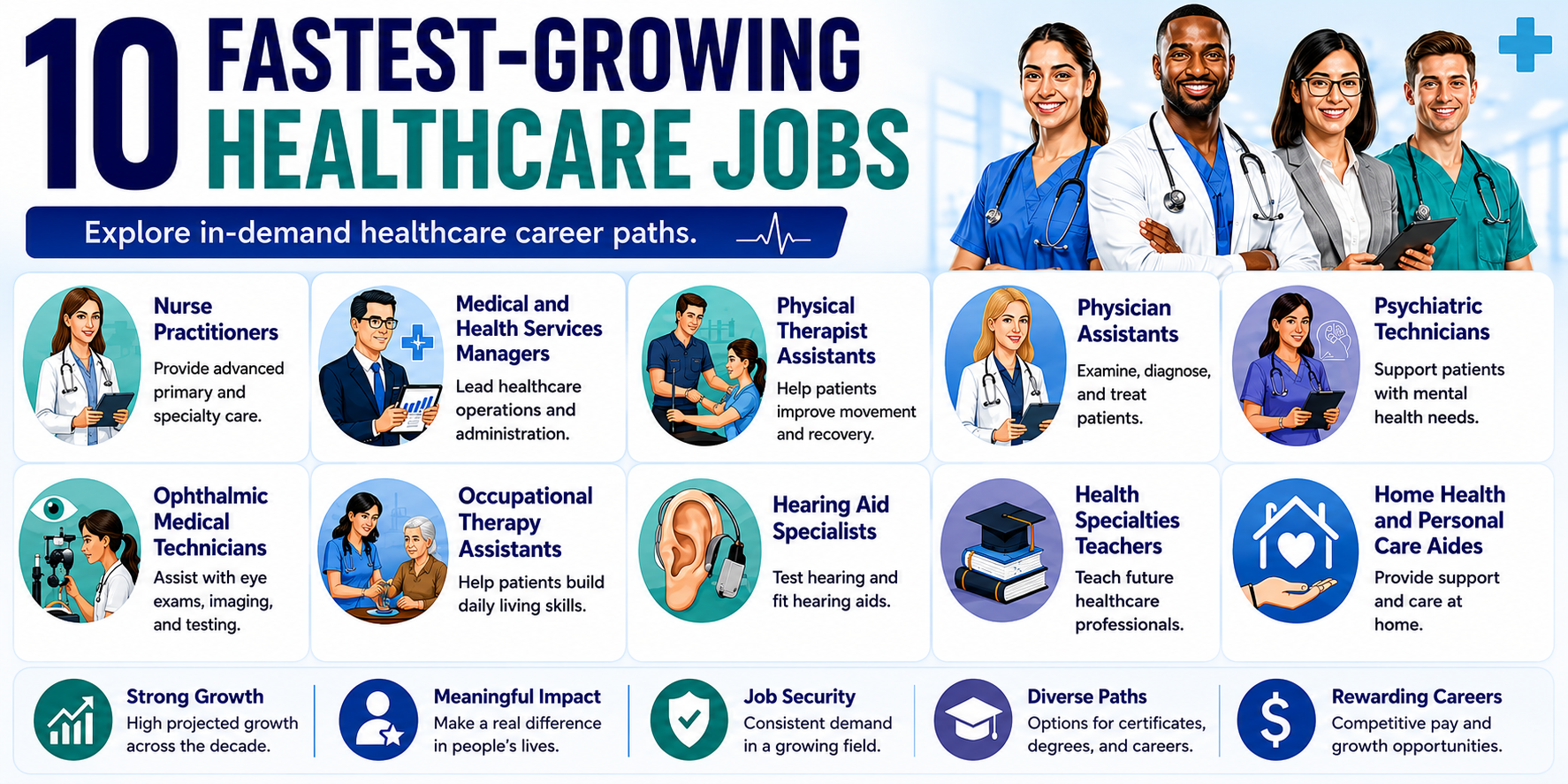
Healthcare is the most reliable place to build a career in 2026. The U.S. Bureau of Labor Statistics projects about 1.9 million openings a year in healthcare occupations over the decade, far more than any other sector. The list below ranks the 10 fastest-growing healthcare jobs by projected growth from 2024 to 2034, straight from BLS data, and shows what each pays, what education it needs, and how to train for the ones you can enter quickly.
Which of These Jobs Can You Train For Fastest?
If you want to be working soon, focus on the roles that need a certificate or a two-year degree rather than a master's.
Psychiatric technicians, ophthalmic medical technicians, and hearing aid specialists all start with a certificate. Physical therapist assistants and occupational therapy assistants need a two-year associate degree but pay in the mid-$60,000s. Home health aide has the lowest barrier of all and the most open jobs.
These are the roles where you can move from decision to employment in months to two years, not the better part of a decade. You can compare programs for any of them on Dreambound by format, length, and cost.
The Best Pick for Career Changers
Medical and health services managers (number two on the list) deserve a closer look if you want into healthcare without handling patient care. With 23% growth, the field needs people who can run the business side of clinics, manage insurance operations, and oversee increasingly AI-integrated hospital systems. A bachelor's degree and transferable management experience can move you in from another industry.
The AI Factor: Why Technology Is Growing These Jobs, Not Replacing Them
AI is not replacing healthcare workers; it is raising demand for the people who operate AI-driven tools. Ophthalmic and imaging technicians are becoming the human-in-the-loop for AI screenings, validating results and managing higher scan volumes. Student choice data reflects the shift: EKG technician training grew 83% year over year in actual student sign-ups, the fastest-growing program category on the Dreambound platform.
How to Start Training for a Fast-Growing Healthcare Career
The roles above range from quick certificates to advanced degrees. If you want to start soon, a few related healthcare programs are among the most accessible ways in, and some lead to roles that pay more than most jobs on the list.
Two high-paying associate-degree roles are worth knowing about. Radiation therapists earn a median of $101,990 and dental hygienists earn $94,260, both with a two-year degree, among the best pay-to-education ratios in healthcare. Radiologic technology is a common way into the imaging field:
Radiology Technician Training - CCI Training Center
- Format: Online instruction plus local clinical rotations, available nationwide
- Length: 8-month limited-scope certificate (4 months online, 4 months clinical)
- ACCET-accredited; eligible for ARRT Limited Scope certification
Medical Radiography, Associate's - ECPI University (Manassas)
- Format: Hybrid, Manassas, Virginia
- Length: AAS in as little as 18 months
- JRCERT-accredited; ARRT exam eligible
For the fastest, most flexible training, medical assistant and dental assistant are two of the most accessible entry points in healthcare. Both grow faster than the all-occupation average (medical assistant at 12%, with about 112,300 openings a year) even though neither ranks in the top 10 above.
Frequently Asked Questions
What is the fastest-growing job in healthcare?
Nurse practitioners are the fastest-growing healthcare job, with employment projected to grow 40% from 2024 to 2034, according to BLS. They also earn the second-highest median pay on this list at $129,210. The role requires a master's degree.
What is the quickest medical career to get into?
The quickest paths are certificate roles like psychiatric technician, ophthalmic medical technician, and hearing aid specialist, plus home health aide, which needs only a high school diploma. Most certificate programs take a year or less, so you can be working in months rather than years.
Which healthcare jobs are in demand in the USA?
All 10 roles on this list are in high demand, growing 17% to 40% through 2034. By sheer volume, home health and personal care aides, medical and health services managers, and physician assistants are adding the most jobs, while medical assistants add about 112,300 openings a year.
Is healthcare the fastest-growing industry in the US?
Healthcare is among the fastest-growing sectors, projected to add about 1.9 million openings a year through 2034, more than any other occupational group. An aging population and rising rates of chronic conditions are the main drivers.
Choosing Your Path in a Growing Field
The healthcare jobs growing fastest in 2026 run from quick certificates to advanced degrees, so the right one depends on how much time you can invest and the kind of work you want. The roles you can train for in under two years, physical therapist and occupational therapy assistants, the certificate technician roles, and home health aide, are the fastest ways into a field that is hiring everywhere. Compare verified programs on Dreambound by format, length, and cost to find the one that fits your timeline.