10 Top Healthcare Certifications That Pay Well
See if you qualify for training programs
Answer a few questions in 2 minutes. Free, no commitment.
You do not need a four-year degree to earn a strong salary in healthcare. Many of the best-paying roles in the field require nothing more than a focused certification program, a passing exam score, and the drive to get started.
The demand is real. According to the U.S. Bureau of Labor Statistics (BLS), healthcare occupations are projected to add about 1.9 million openings per year through 2034, much faster than the average for all occupations. In 2026, the competition for qualified workers is fierce, and employers are actively hiring certified professionals across clinical and administrative roles.
This guide cuts through the noise. Below are the 10 top healthcare certifications that pay well, built from current BLS wage data, ranked to help you find the highest return on your training time. We also cover what others frequently miss: the ROI of each certification based on salary per month of training, and how to choose based on your specific situation.
Fast-Track Healthcare Certifications With Strong Entry-Level Pay
These certifications have shorter training timelines and serve as strong launch points into a healthcare career.
7. Medical Assistant (CCMA / CMA)
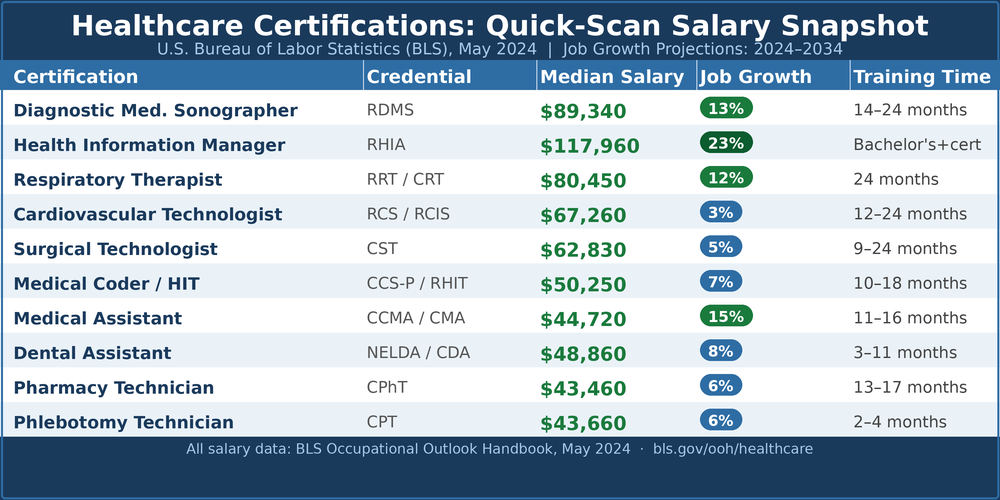
Median Annual Salary: $44,720 (BLS, May 2024) | Job Growth: 15% (2024–2034)
Medical assistants support physicians in both clinical and administrative tasks. The Certified Clinical Medical Assistant (CCMA) from the NHA and the Certified Medical Assistant (CMA) from AAMA are the two leading credentials. Programs typically run 11–16 months.
BLS projects 15% growth for medical assistants through 2034, making it one of the highest-demand entry-level healthcare certifications available.
- 15% growth is among the fastest in all of healthcare
- Dual clinical and administrative role provides broad career flexibility
- Strong stepping stone toward nursing, PA, or healthcare management
Featured Program: Herzing University — Diploma in Medical Assisting
8. Dental Assistant (NELDA / CDA)
Median Annual Salary: $48,860 (BLS, May 2024) | Job Growth: 8% (2024–2034)
Dental assistants work chairside with dentists, preparing equipment, taking X-rays, and managing patient care. The National Entry Level Dental Assistant (NELDA) and Certified Dental Assistant (CDA) from the Dental Assisting National Board (DANB) are the primary credentials.
Most programs take 3–11 months, making this one of the fastest paths to healthcare employment. Private dental practices tend to pay above the median in competitive markets.
- One of the shortest training timelines for a licensed healthcare role
- Strong demand in private practices and specialty dental offices
- 8% projected job growth through 2034
Featured Program: Penn Foster — Dental Assistant Career Diploma
9. Pharmacy Technician (CPhT)
Median Annual Salary: $43,460 (BLS, May 2024) | Job Growth: 6% (2024–2034)
Pharmacy technicians fill prescriptions, manage inventory, and assist pharmacists in retail and hospital settings. The Certified Pharmacy Technician (CPhT) credential from PTCB or ExCPT is required or preferred in most states.
Hospital-based pharmacy tech roles offer significantly higher wages than retail. Top earners in specialized compounding or oncology pharmacy settings exceed $59,450 annually.
- About 49,000 openings projected each year through 2034
- Retail and hospital settings available nationwide
- Good stepping stone toward pharmacy school or clinical pharmacy roles
Featured Program: CCI Training Center — Pharmacy Technician certification
10. Phlebotomy Technician (CPT)
Median Annual Salary: $43,660 (BLS, May 2024) | Job Growth: 6% (2024–2034)
Phlebotomists collect blood samples for tests, transfusions, and donations. It is one of the fastest healthcare certifications you can earn, often completed in 2–4 months. The Certified Phlebotomy Technician (CPT) from NHA is the most widely recognized credential.
With about 18,400 openings projected annually, phlebotomy is an accessible entry point for those transitioning into healthcare with limited prior experience.
- Fastest-to-earn certification on this list: 2–4 months
- About 18,400 annual job openings projected nationwide
- Strong gateway to laboratory technician and clinical roles
What Most Lists Get Wrong: The ROI Lens Competitors Miss
Most articles rank healthcare certifications by salary alone. That tells only part of the story.
The more useful question is: how much can you earn relative to how long it takes to get there? Here is a simplified comparison based on BLS median salaries and typical program lengths:
- Diagnostic Medical Sonographer: ~$89,340/year after 14–24 months — roughly $5,000 per month of training
- Respiratory Therapist: ~$80,450/year after 24 months — roughly $3,350 per month of training
- Surgical Technologist: ~$62,830/year after 9–24 months — up to $6,980 per month of shorter programs
- Medical Assistant: ~$44,720/year after 11–16 months — a consistent mid-range return
- Phlebotomy Technician: ~$43,660/year after just 2–4 months — fastest total time to employment
The right certification is not always the highest-paying one. It depends on your current situation: how much time you have, whether you need clinical experience, and whether you prefer patient-facing or administrative work.
Another gap competitors consistently skip: career trajectory. A phlebotomy certificate or medical assistant credential can open doors to higher-paying roles over time. Many healthcare professionals stack certifications, moving from CPhT to CCS-P or from CCMA to RN over several years.
How to Choose the Right Healthcare Certification in 2026
Start by asking yourself three questions:
- How quickly do I need to be employed? If speed matters most, phlebotomy or dental assisting offers the fastest pathway.
- Do I want to work directly with patients? Clinical roles like surgical tech or respiratory therapy put you at the bedside. Coding and health information roles do not.
- What is my income target? If earning above $70,000 is the goal, focus on diagnostic sonography, respiratory therapy, or cardiovascular technology.
Healthcare practitioners and technical occupations had a median annual wage of $83,090 in May 2024, well above the national median of $49,500 for all occupations. Getting the right certification is one of the most direct paths to closing that gap.
Ready to Start? Explore accredited programs in healthcare! Programs are available online and on-campus across the U.S., with flexible scheduling designed for working adults.